Alaria Sp. - Winged Kelp
Family: Alariaceae [E-flora]
.jpg)
(Wikimedia)1
(Wikimedia)2
(Wikimedia)3
Local Species;
- Alaria marginata - Ribbon kelp
Alaria marginata - Ribbon kelp
"This is one of our most abundant algae, both on the outer coast and in more protected waters with significant tidal currents. It almost invariably grows on rocks. As in other kelps, the sporophyte is the conspicuous generation." (NPS) [E-flora]
"Interestingly, the sporophylls contain various natural chemicals that discourage herbivores although the vegetative blade does not. Herbivores therefore tend to eat only the vegetative blade, leaving the reproductive potential of this alga intact." (NPS) [E-flora]
Description: "Thallus of this common intertidal kelp is brown with a branched holdfast (haptera), a stipe, cylindrical near the base but flattened near the blade, that can reach 30 cm (12 in) or more in length, and a thin, lanceolate blade up to 3 m (10 ft) long with solid midrib. Twenty to forty elliptical sporophylls form in spring on the upper portion of the stipe and grow up to 25 cm (10 in) long, thickening with maturity." [Seaweedsofalaska.com]
"Habitat: This kelp is an annual found on rock in the mid to low intertidal from semi-protected (if there is sufficient current) to exposed habitats." [Seaweedsofalaska.com] "NE Pacific (Alaska to Oregon, Aleutian Is); Asia (Japan, Russia)." [Pereira ESW]
Habitat/Range:
"Bathymetry: mostly mid-low intertidal
World Distribution: Kodiak Island, Alaska, to Point Conception, California" (NPS) [E-flora]
Edible Uses
A. marginata; "Used as food in British Columbia (Canada) (Levring et al. 1969, Kuhnlein and Turner 1996, Zemke-White and Ohno 1999, Lindstrom 2006, Harrison 2013, Kellogg and Lila 2013, Edibleseaweed 2014). In Alaska, when fresh the midrib of Alaria is often cut out, creating two sheets and a thick celery-like stalk. The midrib can be chopped fresh and quickly stirfried. The two side sheets can be used like a tortilla. Rice and fish are piled in the center and the seaweed sheet is rolled. Dried fronds or strips may be broken into pieces. Store the pieces in airtight containers, in a cool, dry place (Garza 2005, Roo et al. 2007)." [Pereira ESW] "Alaria is tasty raw or lightly dressed with a vinaigrette. It is a great seaweed for cooking into sauces and soups." [Jones TDFB] "Used by Nuu-chah-nulth for collecting herring eggs; sometimes eaten with them" [Turner&Kuhnlein]
"Ribbon Kelp is an excellent edible for human use. The midrib can be chopped into bite-sized pieces and added to salads or oriental dishes, to spaghetti sauce, or even deep fried to make a substitute for potato chips. This kelp is a good source of vitamins B6 and K, iodine and potassium, and is over 6% protein when harvested in good condition. Lou Barr of Auke Bay, Alaska, has seen Sitka Black-tailed Deer eat Ribbon Kelp when they are forced down into intertidal areas to feed during times of extremely heavy snowfall. How well they digest it is unknown. It has moderate caloric value (3.31 Calories per gram of dry weight)."(NPS) [E-flora]
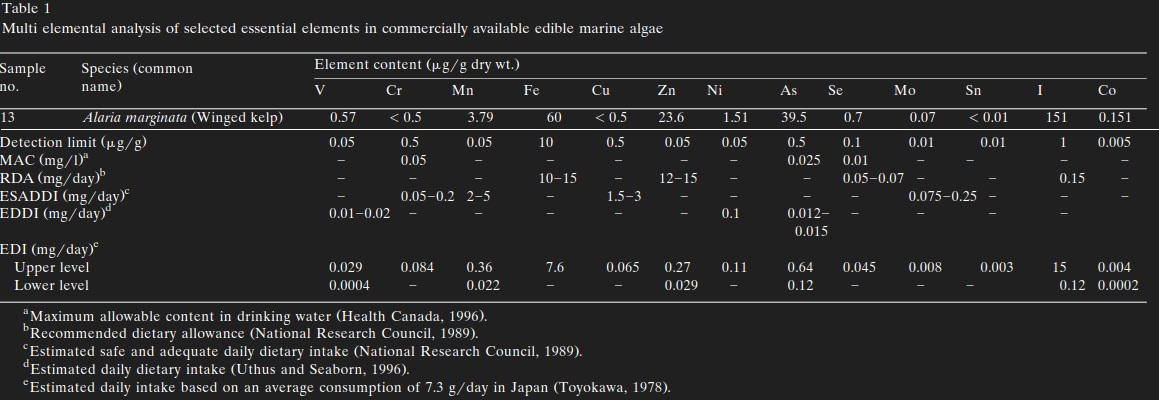
Heavy metals
 (netten2000)
Syn
- Alaria nana Schrader [E-flora]
- Alaria taeniata Kjellman [E-flora]
- Alaria tenuifolia Setchell [E-flora]
Other Non-local Sp.
Preservation: "Sun dry, store in tight plastic bags, or freeze (if frozen, use within three months). Dried alaria, when reconstituted in water, is very much like the fresh plant. The fresh plant has a very short shelf life, even if refrigerated, so preserve soon after harvesting." [SV mcconnaughey]
Harvesting:"Late winter to early summer: clip the seaweed above the tonguelike leaflets (sporophylls) located near the hold fast. If harvested in this manner, the sea vegetable will continue producing new blade growth. Blades have been reported to grow over 12 inches within 24 hours. Late spring to autumn." [SV mcconnaughey] "Rinse kelp and Alaria (brown algae) in fresh water before drying." [Jones TDFB]
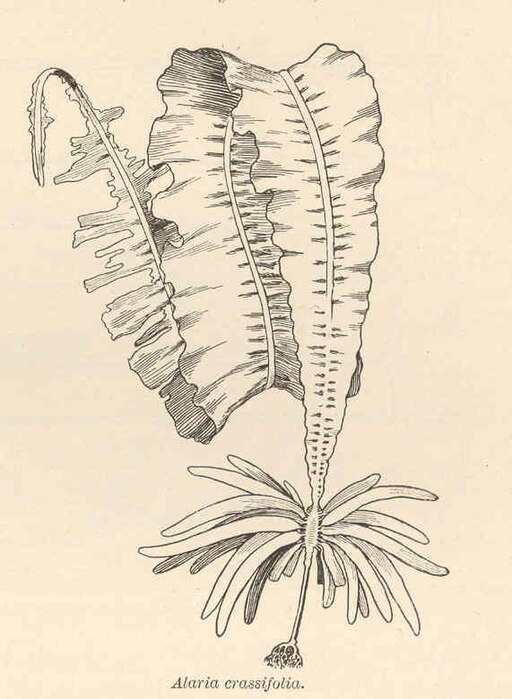
Alaria crassifolia
- Distibution: "Asia (China, Japan)." [Pereira ESW]
A. crassifolia; "Used as food in China, Japan and Korea" [Pereira ESW]
Biochemicals
"A separate examination of the fat obtained from the thallus and the fructification of Alaria crassifolia K]ellm (126) showed that the former contained only about half as much solid fatty acid (23.2%) as the latter (51.02%)." (Mautner)
Alaria esculenta;
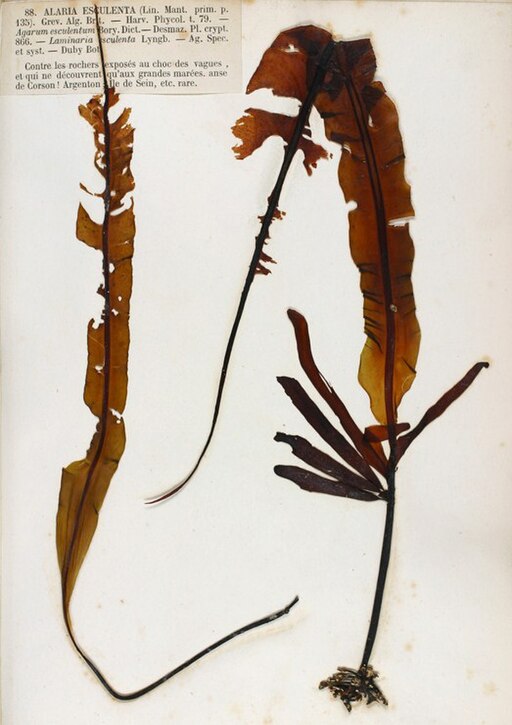
Distribution: "NE Atlantic (France, Scotland, Ireland, Greenland, Iceland, NE US, NE Canada); N Sea (England, Norway, the Netherlands); Pacifi c (Bering Sea and Sea of Japan)." [Pereira ESW] "It has a wide distribution in cold waters and does not
survive above 16oC" [Barsanti Algae]
A. esculenta; "The seaweed is edible and used to be commonly served either as a vegetable or a salad leaf in Ireland, Scotland and Iceland (Johnston 1970, Zemke-White and Ohno 1999); is also consumed in Siberia (Eidlitz 1969), Orkney Is and Norway (Kiple and Ornelas 2000); it is the only kelp-like seaweed in the British Is that has a distinct midrib and cannot be confused with anything else. It is also the only seaweed with sporophylls. In Canada and the US this seaweed is sometimes sold as “Atlantic wakame” and is presented as an alternative to Japanese wakame (Undaria pinnatifida)." [Pereira ESW] "The kind of algae the Chukchi preferred to use as food was Alaria esculenta. It was eaten fresh during winter and spring, although not the plant as a whole, but the midrib." [Svanberg EE] "Eaten in Ireland, Scotland (U.K.), and Iceland either fresh or cooked, it is said to have the best protein among the kelps and is also rich in trace metals and vitamins, especially niacin. It is usually collected from the wild and eaten by local people, and while it has been successfully cultivated, this has not been extended to a commercial scale." [Barsanti Algae] "In many cases, dried winged kelp can be substituted for Japanese wakame in recipes, but it requires a longer soaking time (ca. 20 minutes). After it has been rehydrated in cold water, dried winged kelp is almost as good as fresh. It has a mild taste and can be used as a salad. The midrib is edible if it is toasted and deep frying the sporophylls brings out a taste that is reminiscent of peanuts." [Mouritsen Seaweeds]
"Some species of seaweed – especially ... Alaria esculenta (L.) Greville – were gathered along the shores on some Faroese islands. Seaweed was still gathered as food in the 1930s [10,15,20]." [Svanberg and Ægisson]
Biochemicals
"Brown seaweeds such as Alaria esculenta, Ascophyllum nodosum, Ectocarpus siliculosus, Fucus serratus, F. spiralis, F. vesiculosus, Halidrys siliquosa, Laminaria digitata, L. hyperborea, L. saccharina and Pilayella littoralis contain osmolytes such as mannitol as an impor- tant protective compound in response to abiotic stressors. Mannitol is also known as a chelating agent and explains the reason that sea- weed is able to release unavailable elements of the soil (Reed et al., 1985)." (battacharyya2015)
Alaria fistulosa - Dragon kelp (Now listed as Eualaria fistulosa)
"Scuba divers are familiar with the impressive Dragon Kelp, an important canopy-forming subtidal species in the northern part of the area covered by this book. Specimens to 25 m (82 ft) in length have been measured. This massive kelp is dark brown in color and has a vegetative blade (which does not carry reproductive organs) with a distinct midrib 2 to 3 cm (0.8 to 1.2 in) wide. The midrib is hollow, and bears scattered swollen blisters or gas-filled chambers (hence "fistulosa") that hold the blade up into the upper layers of the water column in order to facilitate photosynthesis. Dragon Kelp is anchored to rocks by a large and much branched holdfast. Between the holdfast and the vegetative blade is a stipe 20 to 25 cm (8 to 10 in) in length and 0.8 to 1.2 cm (0.3 to 0.5 in) in diameter. The stipe is basally cylindrical, but below the vegetative blade it flattens to form a rachis where it carries a variable number of specialized reproductive blades (sporophylls) laterally. The sporophylls of mature individuals are crowded with microscopic, spore-forming organs (sporangia)." (NPS) [E-flora]
"Dragon Kelp can often be found growing intermingled with Bull Kelp (Nereocystis luetkeana)." (NPS) [E-flora]
"Bathymetry: subtidal to at least 12 meters (39 feet)
World Distribution: Aleutian Islands to southern Southeast Alaska; western North Pacific" (NPS) [E-flora]
A. fistulosa; "Alaria esculenta (murlins) is eaten in Northern Europe and Iceland, and A. fistulosa by the Pacific Coast Amerindians." [Wickens, EB]
Syn: Alaria fistulosa [E-flora]
Alaria ochotensis
- Distribution: "Asia (Japan, Russia)." [Pereira ESW]
A. ochotensis; "Used as food in Japan (Tokida 1954)." [Pereira ESW]
Alaria pylaiei - Newfoundland alga
- Distribution: "N Atlantic; Arctic Canada; Atlantic Is (Greenland, Iceland); NE Pacifi c (Alaska)." [Pereira ESW]
A. pylaiei; "Eaten by Icelanders, Inuit (Canada), Ammassalik Is (Greenland), Alaska Indians, and Siberia (Hoygaard 1937, Ostermann 1938, Hallsson 1961, Eidlitz 1969, Kuhnlein and Turner 1996)." [Pereira ESW]
Other Uses
Biogas
"Some seaweed such as Saccharina latissima, Fucus serratus, Laminaria digitata, Alaria esculenta etc are also being used as a source of biogas production (Vivekanand et al. 2012; Schumacher et al. 2011)." [Sahoo TAW] "Kraan et al. (2000) reported that in Ireland, cultured Alaria esculenta, also a kelp species, has a total yield of ~914 kg/m2 (Kraan et al., 2000)." [Tiwari SS]
Fodder
"Brown algae have been used as feed for a long time. According to Spolaore et al. ( 2006 ) about 5–10 % algae can be used safely as partial replacement for conventional proteins in poultry feed. They are also used to feed horses, cows and pigs. In maritime districts many seaweeds such as Sargassum , Fucus , Laminaria , Ascophyllum , Alaria also known as cow weed in Norway, Chorda , Pelvetia , Hormosira are also used as feed (Chapman 1970 )." [Sahoo TAW]
"In Finland and Norway, Laminaria sp. or Alaria sp. are often used as fodder for sheep or cattle." [Fleurence SHDP]
"The Icelanders lay in a store of seaweed for a winter supply by washing the plants and then packing them in trenches where they are compressed with heavy oak planks and stones. The compressed mass is broken up as required and fed to the animals without the smell or taste of milk from cows being affected. Sometimes Alaria, after washing, is air-dried and then stored in layers in barns, each layer alternating with a layer of hay. At least one seaweed meal factory has existed since 1960 and some weed is extracted to provide a liquid plant nutrient. In Iceland, geothermal heat provides a possible cheap means of drying the weed (Hallsson, 1964). In Finland, both Laminaria and Alaria are used as fodder for cattle." [Chapman SU]
"Palmaria palmata and Alaria esculenta have been used as winter fodder since the fifth century in north-western Europe (coastal areas) in feeding domestic animals: sheep, cattle and horses (Balasse et al., 2005). A. nodosum was extensively investigated as fodder for dairy cows, sheep, hogs and poultry and was showed to improve growth of animals if supplemented on the level lower than 10% (Craigie, 2011)." [HMA]
"Alaria fistulosa... mixed with meal and fed to pigs, especially after farrowing." [Wickens, EB]
Potash
"As a result of these developments the production of fertilizers and potash salts from seaweeds was commenced on a commercial scale in 1912. The three kelps which occur in sufficient economic quantity are Macrocystis, Nereocystis and Alaria fistulosa. Pelagophycus contains a higher percentage potash than the other three, but it is not sufficiently abundant to be worked by itself." Alaria was the least valuable source of potash and iodine compared to Nereocytisus, Macrocystis and Pelagophycus, having between 2.9-13.1% (dry wt. %) potash and trace iodine [Chapman SU]
Manure
"Farther north, in Alaska, Alaria fistulosa is regularly employed as a manure for potatoes and the results are extremely satisfactory." [Chapman SU]
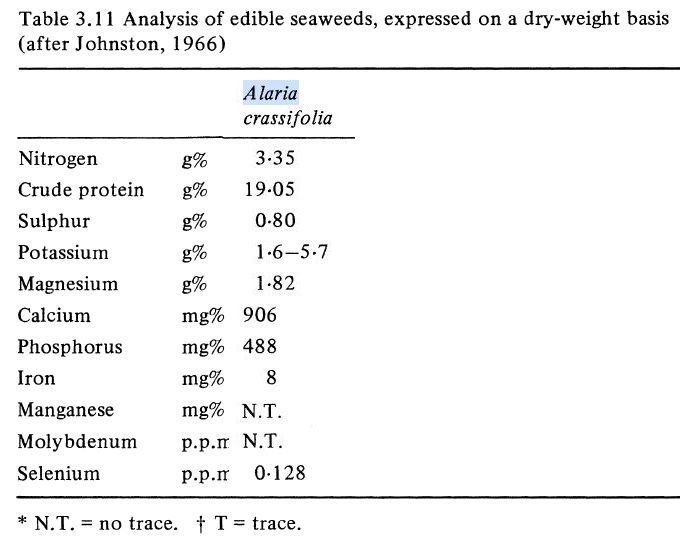
Biochemisty
 [Chapman SU]
 [Chapman SU]

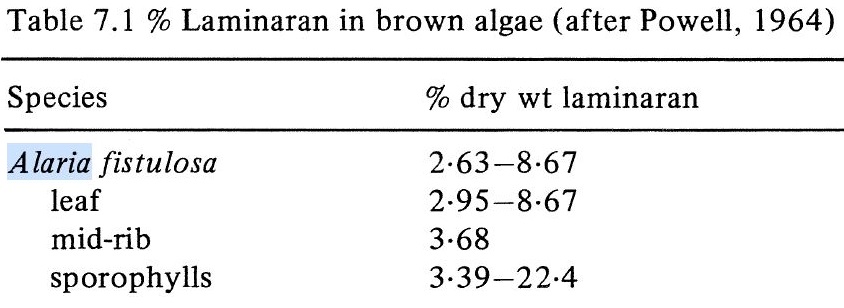 [Chapman SU]
 [C. van Netten et al.]
 [HMA]
[HMA]
 [HMA]
[HMA]
 [HMA]
[HMA]
 [HMA]
[HMA]
 [HMA]
[HMA]
Alaria crassifolia - 23.2% solid fatty acid [Mautner]
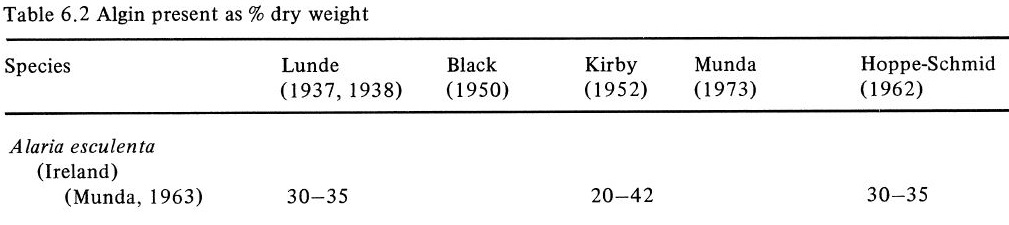
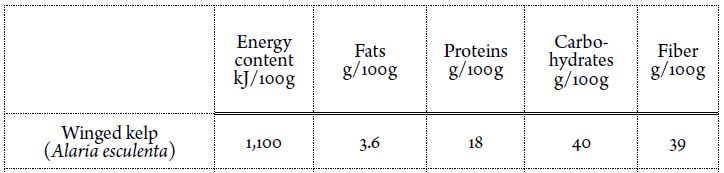
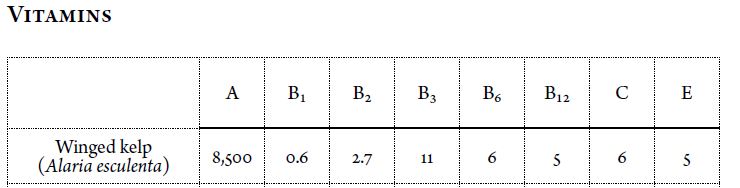
Alaria esculenta: (% dry wt.) Protein 9–20%, Dietary fiber 42.86%, Carbohydrate 46–51%, Lipid 1–2% Vitamins: 0.3-1ppm B2 (Riboflavin), 5ppm B3 (Niacin), 0.1ppm B6 (Pyroxine) and 100-500ppm C (Ascorbic Acid) [Pereira ESW]
"Most brown seaweed, with the exception of Undaria pinnatifida (wakame) and Alaria esculenta, which contain protein levels in the range 11–24 and 9–20% (w/w) respectively, has a maximum protein content of 15% (w/w) (Burtin, 2003; Fleurence, 2004; Morrissey et al., 2001)." [MPP Kim]
"Some fucoidans may contain fucose and galactose in comparable amounts. Such polysaccharides were extracted from sporophylls of Alaria fistulosa (Usov et al. , 2005)" [Dominguez FIAFN]
"Surprisingly, these authors observed absence of laminaran and fucoidan in Alaria species, which is known as a rich source of these polysaccharides."[HMA] "Laminarin consist of a group of {J-D-glucopyranose units linked through carbon atoms 1 and 3. They are produced by the brown algae, especially the sporophylls of Alaria and Laminaria spp. (kelps) and to a lesser extent by members of the Fucaceae (rockweeds), and by the Diatoms." [Wickens, EB]
"In the kelp Alaria, phlorotannin content of the sporophylls is much greater than that of the vegetative portions (Steinberg, 1984)," [Rosenthal HerbV2]
Pharmacology
"An inhibition of alpha-amylase and alpha-glucosidase has been shown for various extracts of brown seaweeds such as Fucus distichus and Alaria marginata (Kellogg et al., 2014)" [Fluerence SHDP]
Antitumor: Alaria esculenta - Crude polyphenol extract - Reduced viability of Caco-2 cells. (Nwosu et al. (2011)) [Qin BSFA] Alaria sp. - Fucoidan - negative proliferation and colony formation against melanoma (Vishchuk et al. 2012)[Teas&Irhimeh,2016]
"It has been suggested that the positive effect of seaweeds is due to their enhancing the metabolic breakdown of estrogen, especially estradiol, in the stomach and the intestines. Clinical studies have shown that by eating five grams of brown algae (Alaria esculenta) daily, post-menopausal women in the West can reduce the estradiol level in the blood to the same level as that of Japanese women." [Mouritsen Seaweeds]
Dermatological Use
"Stimulating collagen synthesis is still one of the mechanisms most frequently employed to combat wrinkles. SEPPIC, a supplier of ingredients for the cosmetics industry, is offering a lipophilic extract of an edible brown alga, Alaria esculenta (Kalpariane® AD). A significant reduction of cutaneous progerin has been demonstrated (Verdy et al., 2011). The mutated form of the gene implicated in over 90% of the known cases of progeria or Hutchinson–Gilford syndrome, which is characterized by accelerated aging, was identified in the early 2000s. The gene involved is the LMNA gene, which is located on chromosome 1 and codes for the lamin A and C proteins. The mutated form of this gene produces a truncated protein, progerin, which remains anchored to the nuclear membrane in cells, where it accumulates and causes dysfunctions (De Sander-Giovannoli et al., 2003; Eriksson et al., 2003; Goldman et al., 2003). In addition, the A. esculenta extract is apparently capable of significantly reducing the expression of the Pmel17 gene implicated in the transfer of melanin to melanosomes. Hence applications in the area of age spot removal are conceivable (Verdy et al., 2012). The selling points of Kalpariane® AD are limited to claims that it increases the firmness and elasticity of the skin when used at a recommended dose of 1% in the formulated product. A. esculenta extract is one of the active ingredients of Algologie Firming Anti-Dark Spot Serum®." [Fluerence SHDP]
Cultivation
"Likewise, the optimum temperature for photosynthesis in zoospores of Alaria esculenta, Laminaria digitata, and Saccharina latissima from Arctic Spitsbergen is with 7–13oC relatively low (Roleda 2009)." [ECOStud-219] "Alaria thrive primarily in rapid tideways." [Chapman SU]
"Since Nereocystis is an annual and the large leafy part of Alaria is similar, both these plants have to be harvested after sporing has taken place, otherwise there might be no young plants to provide an abundant supply for the following season. North of Point Sur to Vancouver Island, July is suggested as the earliest month for reaping, whilst farther north in Alaska, August would be the earliest because development is somewhat later on account of the shorter growing season." [Chapman SU]
Predation
"A number of amphipods are known to bore in kelp stipes and hollow them, causing considerable damage which may eventually lead to the death of the host....In Ireland, Alaria esculenta is inhabited by Amphitholina cuniculus (Myers 1974; Chess 1993)." (Neill, Kate et al.,2008)
"Fungi The ascomycete Phycomelaina laminariae causes the “stipe blotch disease” in laminarian species from the north-western and north-eastern Atlantic. Its hyphae penetrate the surface of Alaria esculenta, Saccharina latissima, S. longicruris and Laminaria digitata, leading to necrotic tissue and reduced overall performance of the host thalli (Sutherland 1915b, c; Kohlmeyer 1968; Kohlmeyer 1979; Schatz et al. 1979; Schatz 1980, 1983, 1984a, c; Goff & Glasgow 1980; Porter & Farnham 1986a)." (Neill, Kate et al.,2008)
"Other algae Green algae are occasionally observed growing in kelps, however very little information is available on their impact on the host species." (Neill, Kate et al.,2008)
"The green endophyte Bolbocoleon piliferum is found on the east and west coast of the USA, and eastern Canada, growing in the kelps Alaria marginata,...." (Neill, Kate et al.,2008)
"Traditionally, kelp endophytes have been classified as Streblonema species (Goff & Glasgow 1980), for example, the endophytes that affect Saccharina sessilis, Alaria tenuifolia, Laminaria setchellii and Nereocystis luetkeana along the North American west coast (Setchell & Gardner 1922)." (Neill, Kate et al.,2008)
"North Atlantic kelp populations are infected by two species of Laminariocolax: L. tomentosoides and L. aecidioides. The former is mainly found in Laminaria digitata, but occasionally also in L. hyperborea, Saccharina latissima and Alaria sp...." (Neill, Kate et al.,2008)
"The genus Microspongium is occasionally found as endophyte in kelps. On the east coast of North America, Alaria esculenta and Saccharina longicruris are infected by Microspongium alariae, with symptoms ranging from dark spots to twisted stipes (Peters 2003)." (Neill, Kate et al.,2008)
"Gametophytes of kelps themselves colonise other algae as endophytes. A genetic study has revealed that endophytic brown algae growing in Lessoniopsis littoralis from British Columbia, Canada, are gametophytes of other kelps growing near the host, i.e. of Alaria sp., Macrocystis integrifolia and Nereocystis luetkeana (Lane & Saunders 2005)." (Neill, Kate et al.,2008)
References
- (battacharyya2015) Battacharyya, Dhriti, et al. "Seaweed extracts as biostimulants in horticulture." Scientia horticulturae 196 (2015): 39-48.
- C. van Netten et al. - Elemental and radioactive analysis of commercially available seaweed, C. van Netten, S.A. Hoption Cann, D.R. Morley, J.P. van Netten, The Science of the Total Environment 255 (2000). 169-175
- Mautner - Mautner, Henry G. “The Chemistry of Brown Algae.” Economic Botany, vol. 8, no. 2, 1954, pp. 174–92. JSTOR, http://www.jstor.org/stable/4287808. Accessed 16 July 2025.
- Seaweedsofalaska.com - A. marginata, Accessed March 18, 2015
- Svanberg and Ægisson - Edible wild plant use in the Faroe Islands and Iceland, Ingvar Svanberg, Sigurður Ægisson, 2012 Published by Polish Botanical Society
- Teas&Irhimeh,2016 - Melanoma and brown seaweed: an integrative hypothesis Jane Teas & Mohammad R. Irhimeh, J Appl Phycol DOI 10.1007/s10811-016-0979-0
- (NPS) E-flora - North Pacific Seaweeds by Rita O'Clair and Sandra Lindstrom, In Klinkenberg, Brian. (Editor) 2020. E-Flora BC: Electronic Atlas of the Plants of British Columbia [eflora.bc.ca]. Lab for Advanced Spatial Analysis, Department of Geography, University of British Columbia, Vancouver. [Accessed: 2026-02-10]
- E-flora - Alaria marginata, https://linnet.geog.ubc.ca/Atlas/Atlas.aspx?sciname=Alaria%20marginata&redblue=Both&lifeform=13, [Accessed: 2026-02-10]
- E-flora - Eualaria fistulosa , https://linnet.geog.ubc.ca/Atlas/Atlas.aspx?sciname=Eualaria%20fistulosa, [Accessed: 2026-02-10]
- (Mautner) Mautner, Henry G. "The chemistry of brown algae." Economic Botany 8.2 (1954): 174-192.
- (Neill, Kate et al.,2008) Neill, Kate, Svenja Heesch, and Wendy A. Nelson. Diseases, pathogens and parasites of Undaria pinnatifida. MAF Biosecurity New Zealand, 2008.
- (netten2000) Van Netten, C., et al. "Elemental and radioactive analysis of commercially available seaweed." Science of the Total Environment 255.1-3 (2000): 169-175.
Journals of Interest
- Haug, Arne and Arne Jensen. 1953. Seasonal variations in chemical composition of Alaria esculenta, Laminaria saccharina, Laminaria hyperborea, Laminaria digitata from Northern Norway. Norsk institutt for tang-og tareforskning. Oslo.
- Schiener, P., Black, K.D., Stanley, M.S., Green, D.H., 2015. The seasonal variation in the chemical composition of the kelp species Laminaria digitata, Laminaria hyperborea, Saccharina latissima and Alaria esculenta. J. Appl. Phycol. 27, 363–373.
- Usoltseva, R.V., et al., 2016. The comparison of structure and anticancer activity in vitro of polysaccharides from brown algae Alaria marginata and A. angusta. Carbohyd. Polym. 153, 258–265.
- USOV, A. I., SMIRNOVA, G. P. and KLOCHKOVA, N. G. (2005), ‘Polysaccharides of algae. 58. The polysaccharide composition of the Pacifi c brown alga Alaria fi stulosa P. et R. (Alariaceae, Laminariales)’ , Russ. Chem. Bull. Int. Ed, 54 , 1282–1286 .
- Verdy, C., Branka, J.E., Mekideche, N., 2011. Quantitative assessment of lactate and progerin production in normal human cutaneous cells during normal ageing: effect of an Alaria esculenta extract. Int. J. Cosmet. Sci. 33 (5), 462–466.
- Vishchuk O, Tarbeeva D, Ermakova S, Zvyagintseva T (2012) Structural characteristics and biological activity of fucoidans from the brown algae Alaria sp. and Saccharina japonica of different reproductive status. Chemistry Biodivers 9:817–828
Image References
- 1, Steve Lonhart / NOAA MBNMS, Public domain, via Wikimedia Commons, https://commons.wikimedia.org/wiki/File:Ribbon_kelp_(Alaria_marginata).jpg<
- 2, Pierre-Louis Crouan (1798-1871) & Hippolyte-Marie Crouan (1802-1871), Public domain, via Wikimedia Commons
- 3, Hugh McCormick Smith, Public domain, via Wikimedia Commons
Data Analytics
Source Material Depth
This graph represents the unique prevalence of "Alaria" within the Eflora local research library. Penetration indicates the percentage of total documents containing at least one of the search terms.